Scalable Innovation Management SaaS

Updated: Apr 9
From Rigid Legacy Systems to a Modular Ecosystem Architecture
NDA NOTICE: To strictly comply with confidentiality agreements, all brand names, client identifiers, and high-fidelity screens have been redacted or stylized. This study focuses on the strategic UX methodology and system architecture.

The Challenge: Overcoming Rigid Workflows
The client, a leading firm specialized in innovation management and venture building, required a transformation of their existing digital platform.
The Legacy Issue: The previous system was built on a restrictive "role-locking" mechanism. Users were forced to choose a single identity—Manager or Entrepreneur—which created friction and limited the platform's scalability.
The Goal: To design a holistic, modular, and self-sustaining environment that serves diverse users, from corporate innovation leaders to independent startup teams.
Deep UX Research: Redefining the User Journey
I conducted extensive research to identify the pain points within the existing innovation management landscape.
1-on-1 Interviews: Gained deep insights through direct sessions with program managers and entrepreneurs.
Key Discovery: Innovation is not linear. Users frequently need to "loop back"—for instance, updating a Problem Prioritization Canvas or a Persona after gaining new insights in later stages.
Methodological Foundation: The research proved that the system needed to be deeply rooted in Design Thinking and Lean Startup principles.
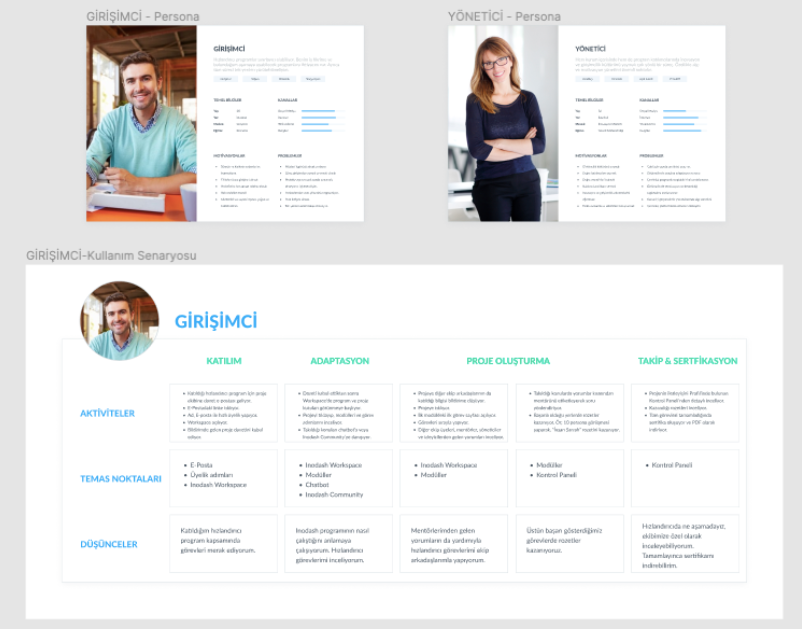
The Solution: A Modular Dual-System Architecture
Instead of a linear path, I architected a flexible "Library" system that mirrors real-world innovation cycles.
1. Dual-System Hierarchy (Programs & Projects)
Programs: A high-level management layer where any user can launch an accelerator or a corporate innovation cycle.
Projects: Sub-layers where independent teams or startup projects can operate autonomously under a specific program.
Flexibility: This structure allows the platform to be used as a modular workspace for various innovation scenarios without pre-defined constraints.

2. Iterative & Non-Linear Experience
The Library Approach: All outputs (Personas, Journey Maps, etc.) are treated as dynamic assets.
Seamless Navigation: Users can progress through defined steps while maintaining the freedom to return and edit any earlier module as their venture evolves.

Outcome & Market Validation
Investment Success: The redesigned platform successfully secured its first round of investment. (500K $)
Product Recognition: The product consistently ranked in the Top 5 on Product Hunt following its launch.
Strategic Growth: The user-centric UI positioned the platform as a leader in the startup acceleration and innovation management space.